
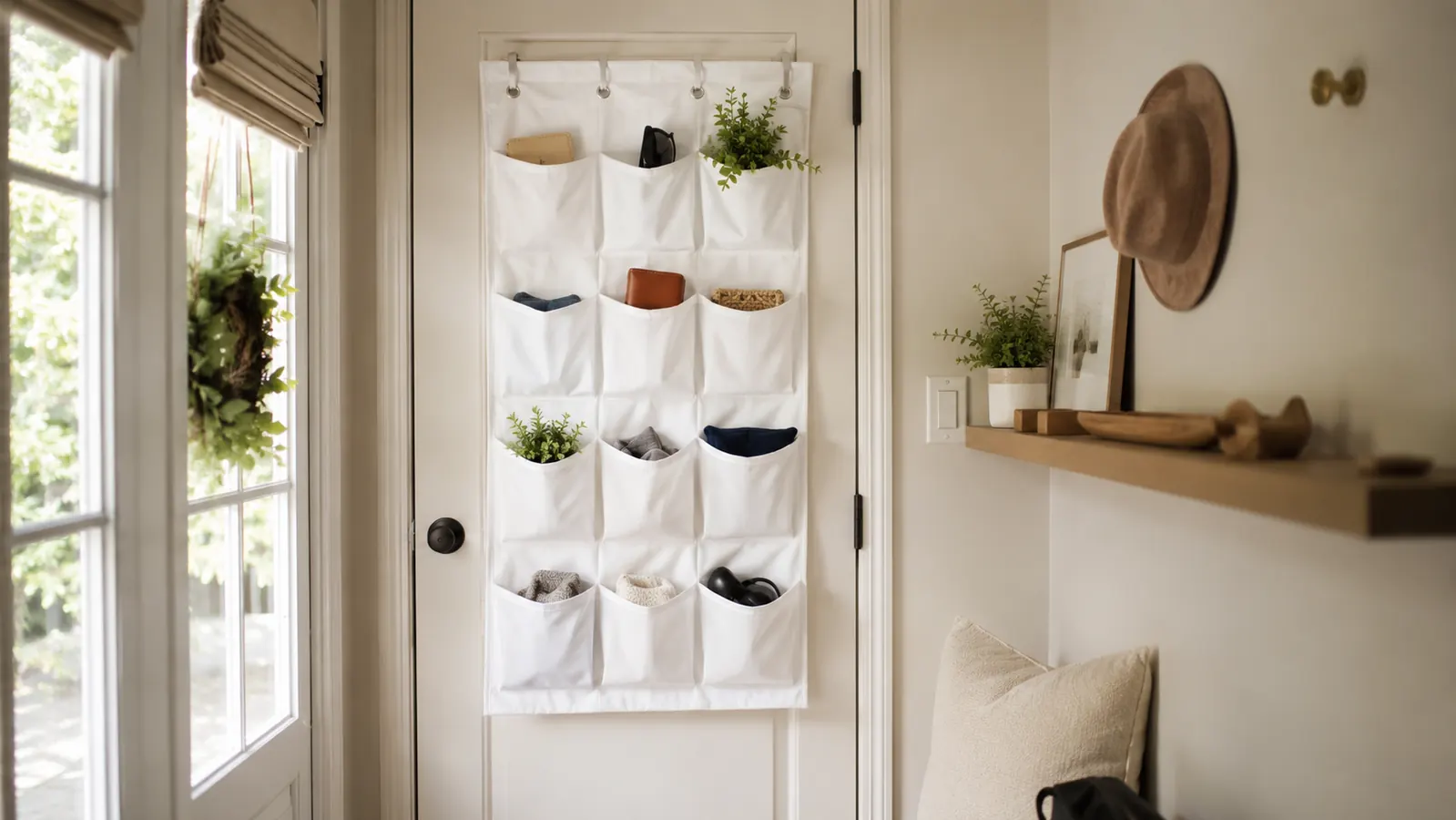
Here is the situation I hear about every few months from a friend or neighbor: they finally decide to get organized, they head to the hardware store or scroll Amazon, and they come home with a wall-mounted shelving kit and a box of anchors. Two hours later there is a crooked shelf, a strip of joint compound drying on the wall, and a spouse who is not thrilled. If you rent, or if you have already patched one too many holes, you start wondering whether there is a better way. The Simple Houseware over-door organizer is one answer to that question. It hooks over a standard interior door with zero tools and holds 24 pockets worth of stuff. But wall-mounted storage, done right, can carry more weight and look more permanent. This comparison breaks down exactly when each one wins so you can buy once and actually be done with it.
The short answer: if you rent, move with any regularity, or need storage on a door where wall space is limited or awkward, the over-door organizer wins on almost every practical point. If you own your space, have a specific wall with open square footage, and want to display or store heavier items, wall-mounted shelving earns its place. But the two solutions are solving slightly different problems, and understanding that difference saves you the return trip.
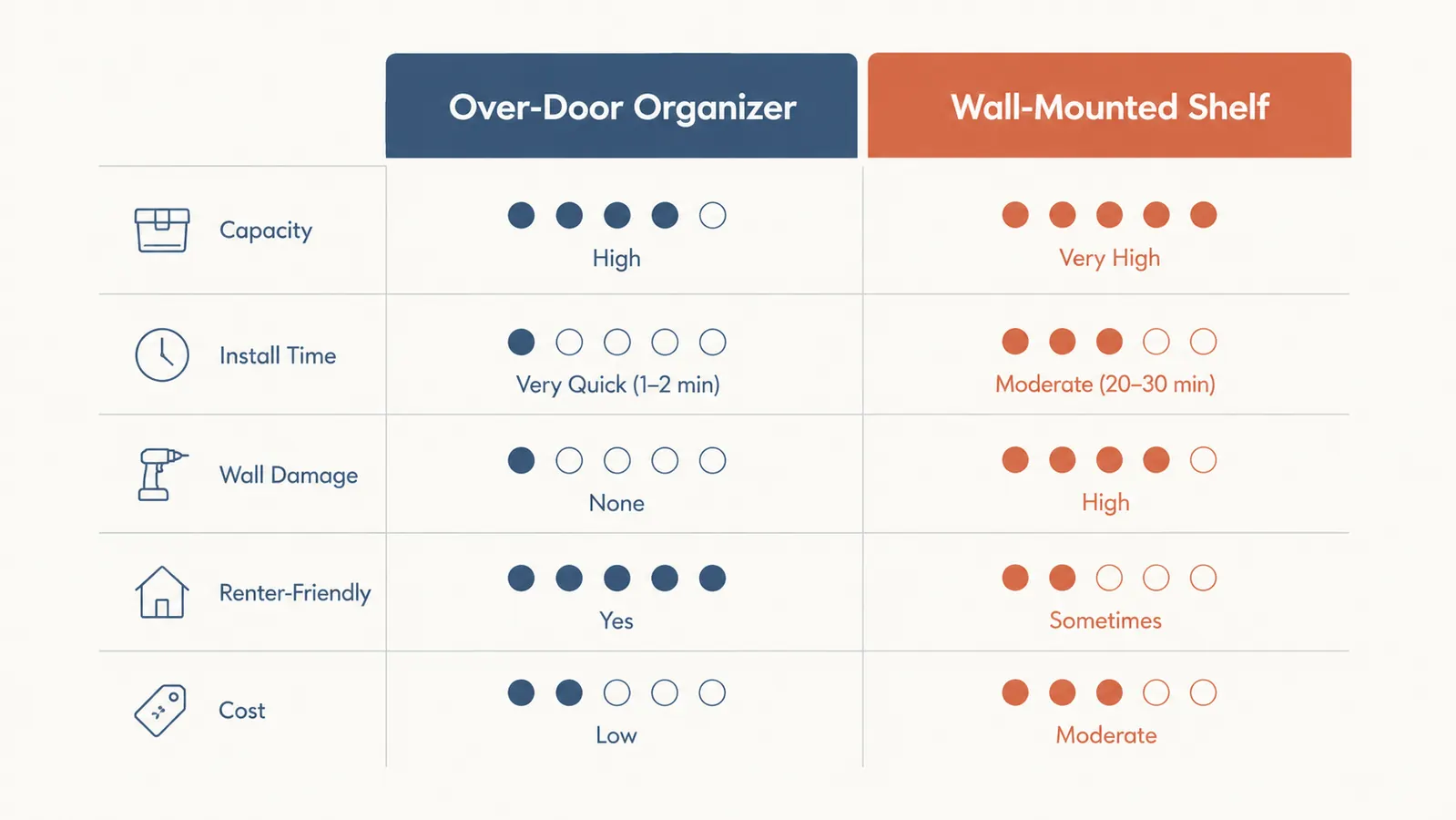
| Over-Door Organizer | Wall-Mounted Storage | |
|---|---|---|
| Price range | Budget-friendly for 24 pockets | Budget to premium depending on shelf size and hardware |
| Installation effort | Hooks over door in under 60 seconds, no tools | Requires level, drill or Command strips, stud-finder for heavier loads |
| Wall damage | None, door frame contacts only | Anchor holes or adhesive residue; risk of drywall damage on removal |
| Weight capacity | Light items (bottles, pouches, small tools) per pocket; total around 10 to 15 lbs | Drilled shelf can hold 20 to 50 lbs; Command strips rated 3 to 16 lbs per strip |
| Renter-friendly | Yes, fully removable with no trace | Command strips: maybe. Drilled shelf: no, requires patching on move-out |
| Storage capacity | 24 separate pockets; ideal for small, grab-and-go items | Open shelf surface; better for bins, boxes, or items too large for pockets |
| Best use case | Bathroom door, pantry door, kids' bedroom door, mudroom, entryway | Open wall in laundry room, garage, or office where heavier or bulkier items need a home |
| Portability | Folds flat, moves to any standard door in seconds | Fixed once installed; moving it requires patching and repainting |
Where the Simple Houseware Over-Door Organizer Wins
The clearest win is the installation. I have three kids, a house full of doors, and genuinely zero patience for projects that take a whole Saturday afternoon and leave a mess. The Simple Houseware organizer goes up in one motion. You hang the two metal hooks over the top of the door and you are done. No measuring, no leveling, no hunting for a stud. It takes less time than heating up a cup of coffee. That matters more than people admit, because a storage solution you actually put up beats a better one still in the box.
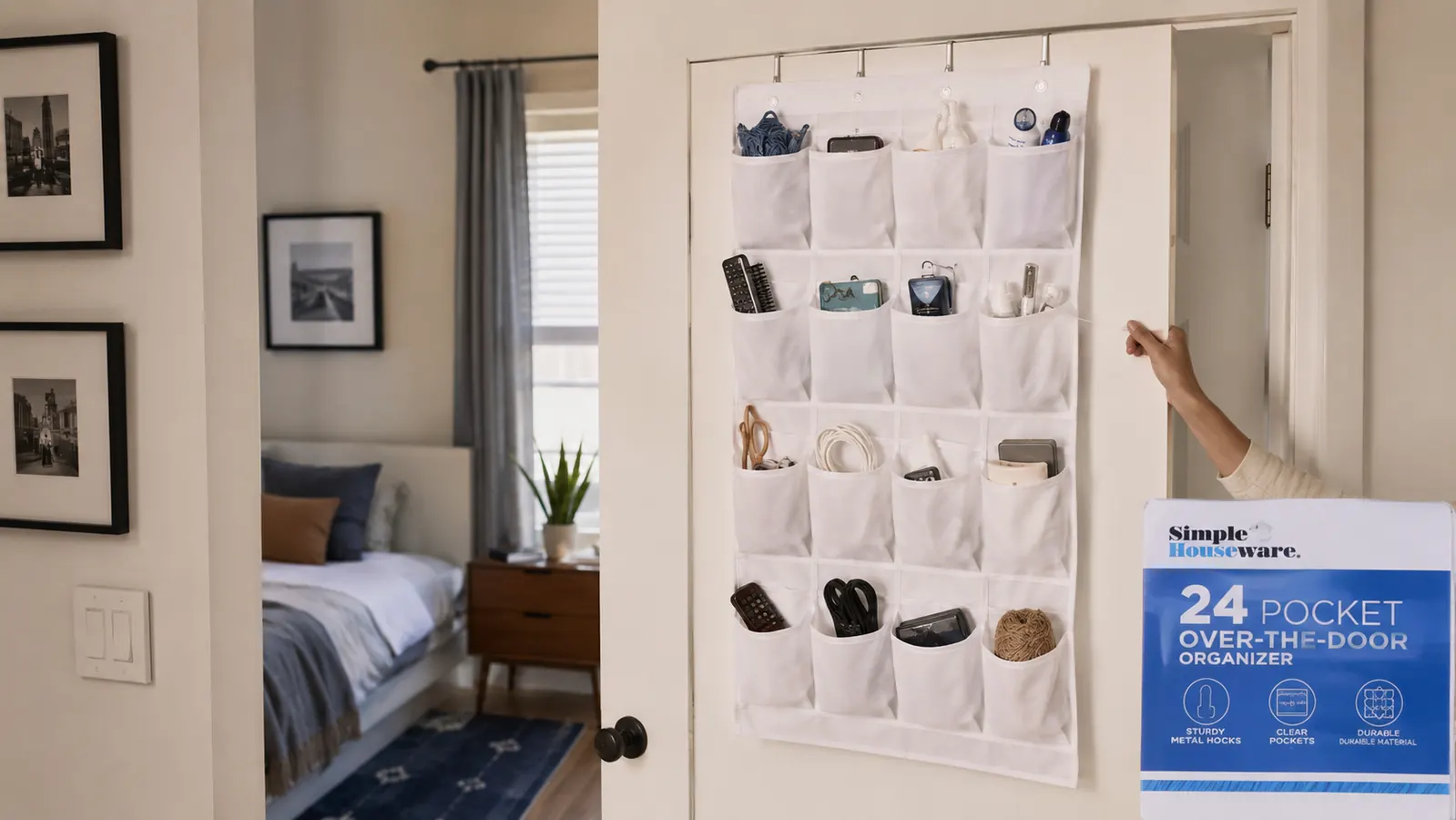
The second win is flexibility. I have moved mine from the pantry door to a bathroom door to my daughter Clara's bedroom door three times in the past year as our storage needs shifted. Each move took about 45 seconds. With wall-mounted shelving, every location change means another round of patching, painting, and reinstalling. The over-door option also works in rentals without the conversation with your landlord about what is and is not allowed. The 24 pockets cover an enormous range of small-item storage: snacks, hair accessories, spray bottles, medicines, chargers, small toys, makeup, cleaning pouches. For anything that lives in a drawer or gets thrown on a counter, this thing is usually a better home.
Where Wall-Mounted Storage Wins
Wall-mounted shelving earns its spot when you need to store something too large, too heavy, or too awkward for a fabric pocket. A row of mason jars on a kitchen wall. A shelf in the laundry room for detergent jugs and a jug of bleach. A garage wall with bins of fasteners. Fabric pockets are not built for that kind of load, and a properly anchored shelf can carry thirty or forty pounds with ease. If you own your home and the storage challenge is genuinely weight-bearing or display-oriented, wall-mounted wins.
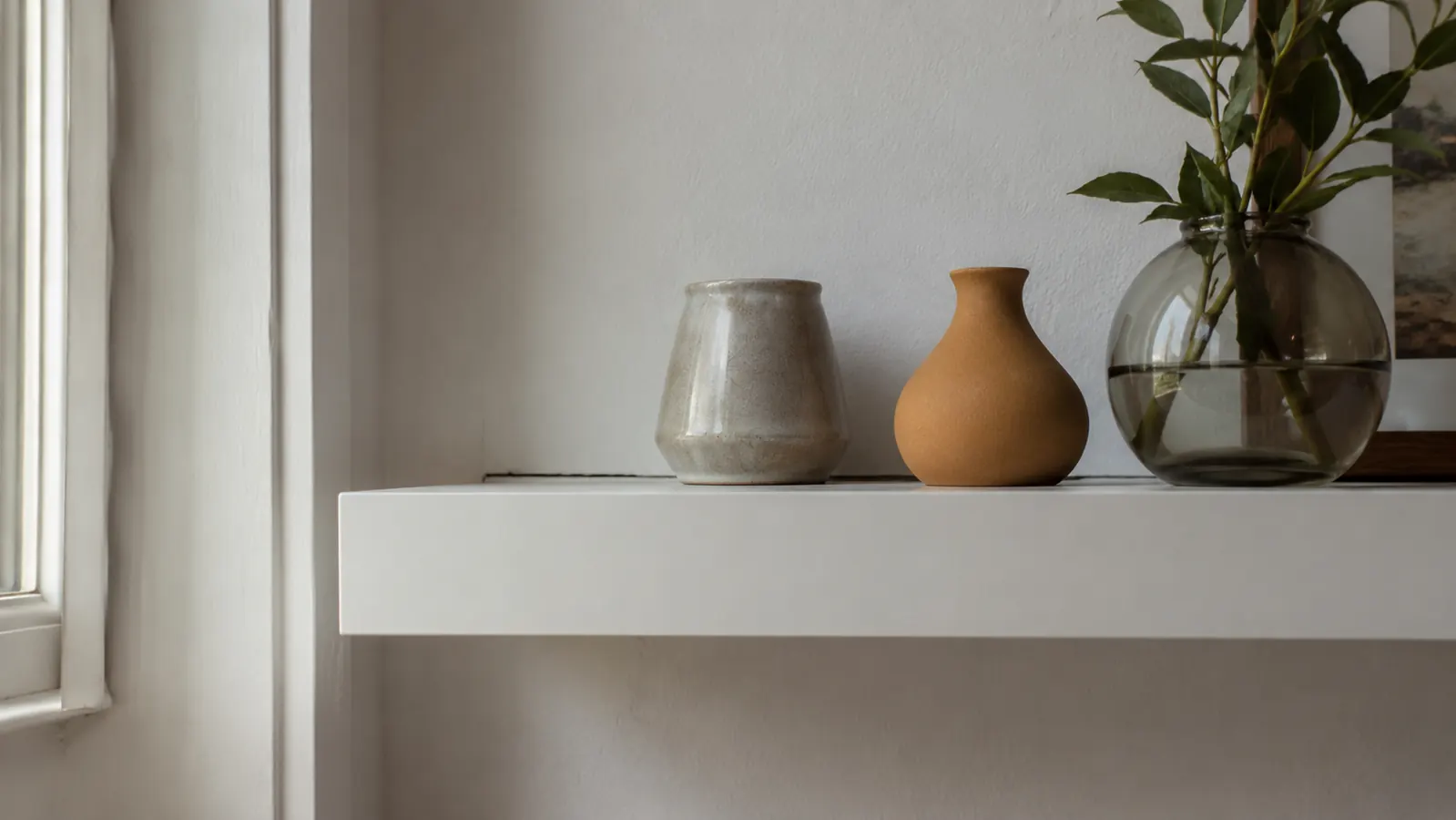
Wall-mounted storage also looks more intentional in a finished room. A floating shelf with a few plants, a candle, and some books reads like decor. A door organizer is purely functional and most people keep it on an interior door that guests do not see. If you want storage that doubles as part of the room design, a shelf wins that round. The tradeoff is everything that comes with putting holes in your walls: the time, the tools, the permanence, and the landlord clause.
If your problem is a door with dead space and stuff that needs a home, this is the easiest fix I know.
The Simple Houseware 24-pocket organizer hangs in under a minute, holds more than it looks like it should, and comes off just as fast when you move or rearrange. Over 132,000 Amazon reviews and a 4.7-star rating back that up. Check today's price and availability before you go looking for anchors.
Amazon Check Today's Price on Amazon →The Command-Strip Shelf Experiment (And Why It Disappointed Me)
I want to be specific here because I think a lot of people try Command-strip shelving as the no-holes middle ground and end up frustrated. I have run that experiment twice in my house. The first time was a small shelf above the bathroom toilet. It held for about four months before the humidity softened the adhesive enough that the shelf gave me a warning lean. I caught it before it fell, but everything on it had to go. The second time I used the larger, heavy-duty strips for a laundry room shelf. That one is still up, and it works, but I loaded it carefully and check it a couple of times a year. The rated weight limit on Command strips is not the same as the comfort weight limit, especially in warm or humid rooms.
The over-door approach avoids all of that physics entirely. The hooks rest on the top of the door frame and the weight pulls straight down. There is no adhesive to fail, no anchor to strip, and no drywall to repair. For the categories of things that fit in a pocket organizer, the over-door solution is simply more reliable over time than Command-strip shelving in most household conditions.
The rated weight limit on Command strips is not the same as the comfort weight limit, especially in warm or humid rooms. The over-door organizer has no adhesive to fail.
Fit and Clearance: What to Check Before You Buy
One question I get is whether over-door organizers fit every door. For most standard interior doors in US homes, yes. The Simple Houseware hooks are designed for doors up to about 1.75 inches thick, which covers the overwhelming majority of hollow-core and solid interior doors. The organizer itself hangs on the back side of the door and the hooks sit on top of the frame, which means the door can still open and close. You do lose about a half inch of clearance, so if your door frame is unusually tight against a wall or piece of furniture when fully open, measure that gap first. In my house across three different door locations, I never had a clearance problem, but it is worth a ten-second check.
The pockets on the Simple Houseware are clear vinyl, which is one of the features I actually rely on. I can see what is in each pocket without pulling things out. That matters especially on the pantry door where my kids need to find snacks fast without emptying everything onto the floor. The pockets are sized for bottles, pouches, small boxes, and similar items. They are not deep enough for full-size cereal boxes or large cleaning spray bottles, but for the hundred smaller things that drift around a house without a home, they work perfectly.
Who Should Buy Which
Buy the over-door organizer if you rent, move more than once every few years, have a door with unused space and a clutter problem nearby, or simply want storage up and working today rather than this weekend. It is also the better pick for kids' rooms, bathrooms, pantries, and anywhere small items keep escaping their designated spot. At the price point, you can put one on several doors at once and solve multiple clutter hotspots in a single order. I have written more about how I set these up in kids' rooms specifically in my guide on organizing a kid's room with over-door pocket organizers, and if you want a full six-month picture of how this organizer holds up across different doors in a real house with kids, my long-term review of the Simple Houseware over-door organizer covers all of that.
Buy wall-mounted shelving if you own your home, have a specific wall with open space, and need to store something heavier or larger than a fabric pocket can handle: bins of supplies, cleaning jugs, tools, kitchen gear, or anything display-worthy that you want to see rather than tuck away behind a door. Just go in knowing it takes more time, more tools, and more commitment than most people budget for, and factor that into whether you will actually finish the install.
No tools, no landlord conversation, no patching drywall on the way out.
The Simple Houseware 24-pocket over-door organizer is the storage solution that is actually ready to use the day it arrives. Hooks over any standard interior door, holds small items you can see at a glance, and moves with you when your needs change. Check today's price to see if it is in stock.
Amazon Check Today's Price on Amazon →