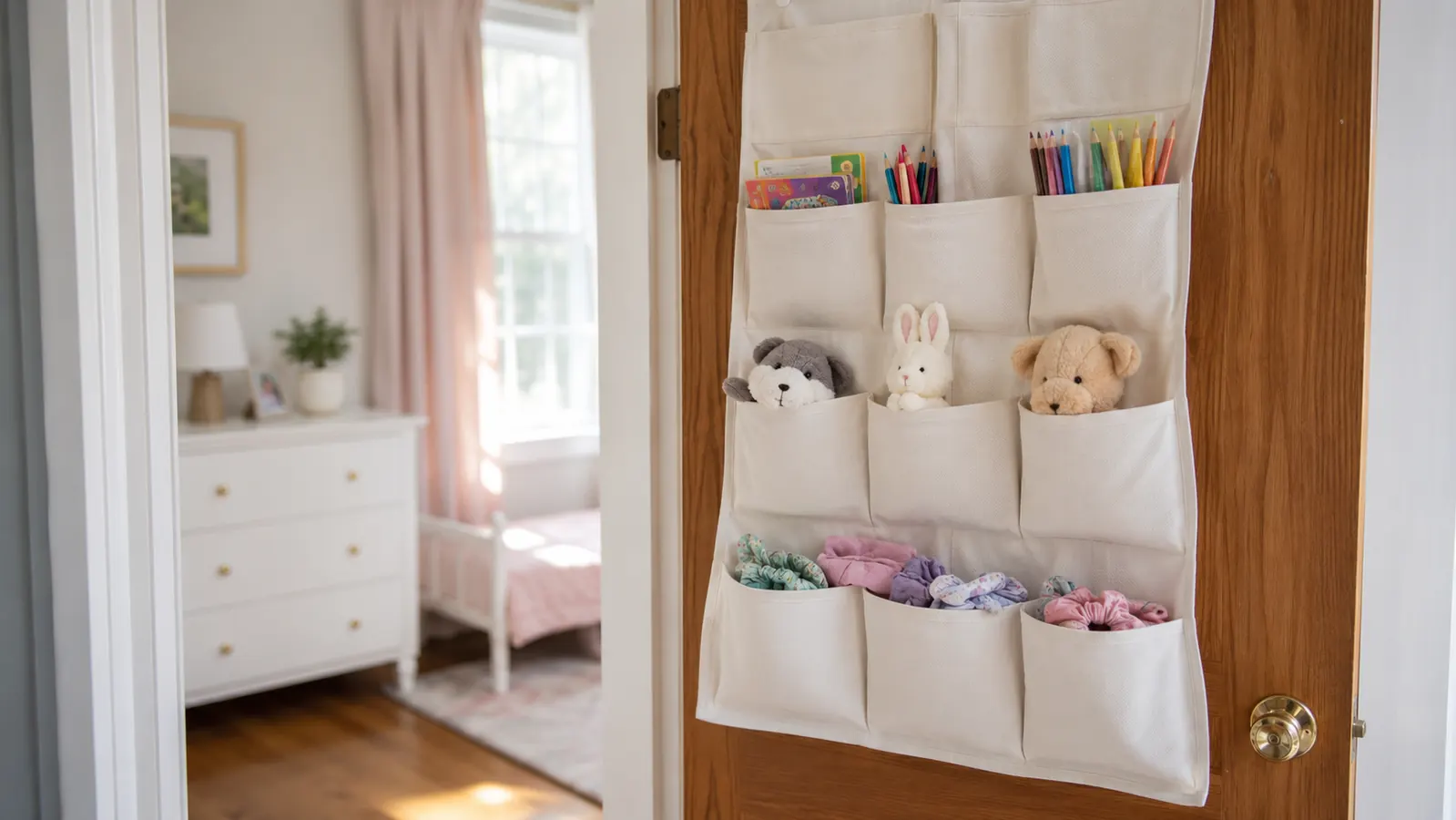
If your kid's room looks like a craft supply explosion collided with a sock drawer, I want you to know: I have stood in that exact doorway. My three kids share two bedrooms, and for years the floors were covered in the small stuff, hair ties, tiny Lego pieces, markers without caps, miniature notebooks, earbuds, and approximately forty-seven items that do not belong to any category I can name. I tried bins on shelves. I tried labeled boxes. I tried a pegboard that took me an entire Saturday to install and lasted three weeks before somebody hung their backpack on it and pulled it off the wall.
The problem with most kids' room storage is that it requires kids to make a decision every single time they put something away. Where does this go? Which bin? Which shelf? The over-door pocket organizer solves that by turning every pocket into its own obvious home. The Simple Houseware 24-pocket over-door organizer is what I use in two of my three kids' rooms, and it is the first storage solution in this house that my kids actually maintain without being reminded. That is not a small thing. Over 132,000 people have bought this organizer and rated it 4.7 stars, and when I started asking other moms about it, I kept hearing the same story: it is the one thing that finally stuck.
The small-stuff problem in kids' rooms finally has a fix that does not require a drill.
The Simple Houseware 24-pocket over-door organizer has 132,000 reviews and a 4.7-star rating for a reason. It hangs in minutes, holds the small clutter that defeats every other system, and comes off the door without a mark when you move.
Amazon Check Today's Price on Amazon →Step 1: Audit What Small Stuff Is Actually Living on the Floor
Before you buy anything or move anything, spend ten minutes doing a floor sweep of the room. Do not organize yet. Just gather every small item off the floor and desk and pile it on the bed. You are looking for patterns: what categories keep reappearing? In my daughter Lily's room, the pile always contained the same five things: hair accessories, colored pencils, small notebooks, charging cables, and the little erasers that come in packs of forty and migrate everywhere. That five-item list told me exactly how many categories I needed to accommodate.
Write the categories down. Do not assume you will remember them. Aim for six to eight categories maximum. If you end up with fifteen categories, you have over-segmented and your kid will never maintain it. The point is broad, obvious buckets: Art Stuff, Hair Stuff, Tech Stuff, Books, Small Toys, and Miscellaneous covers most kids' rooms completely. Fewer categories means faster cleanup because your kid does not have to think about which of six similar bins gets the marker.
Also note anything that is genuinely too large for a pocket organizer. Over-door pockets work brilliantly for anything that fits in the palm of a hand. Books thicker than a paperback, rolled-up posters, and bulky stuffed animals need a different home. Knowing that boundary upfront saves you from cramming the wrong things in and having the whole system fail in week two because the pockets are stretched out and drooping.
Step 2: Choose the Right Door and Confirm the Fit
Not every door in a kid's room works equally well for an over-door pocket organizer. The back of the bedroom door is the most common choice, and it works if the door swings inward and clears the wall by at least two inches when fully open. The over-door hook on the Simple Houseware organizer adds about an inch of thickness to the door frame, so if your door barely clears the baseboard now, measure before you hang. A door that cannot fully open because the organizer is in the way will get pushed and jostled constantly.
The closet door is often an even better choice than the bedroom door. Closet doors swing less frequently throughout the day, which means the organizer stays more stable and the pockets are less likely to get jostled. In my son Marcus's room, we use the closet door because his bedroom door is right next to the light switch and gets slammed roughly twenty times a day. Stability matters when a pocket is holding a cup full of markers.
If the room has a hollow-core door, the over-door hooks sit fine. The Simple Houseware organizer uses a standard over-door hook design that works on doors up to 1.75 inches thick. Check the top edge of the door with a quick measurement before you hang. Most standard interior doors in US homes are 1.375 to 1.75 inches thick, so it fits nearly everywhere without modification.
Step 3: Assign Pockets by Category Before You Fill a Single One
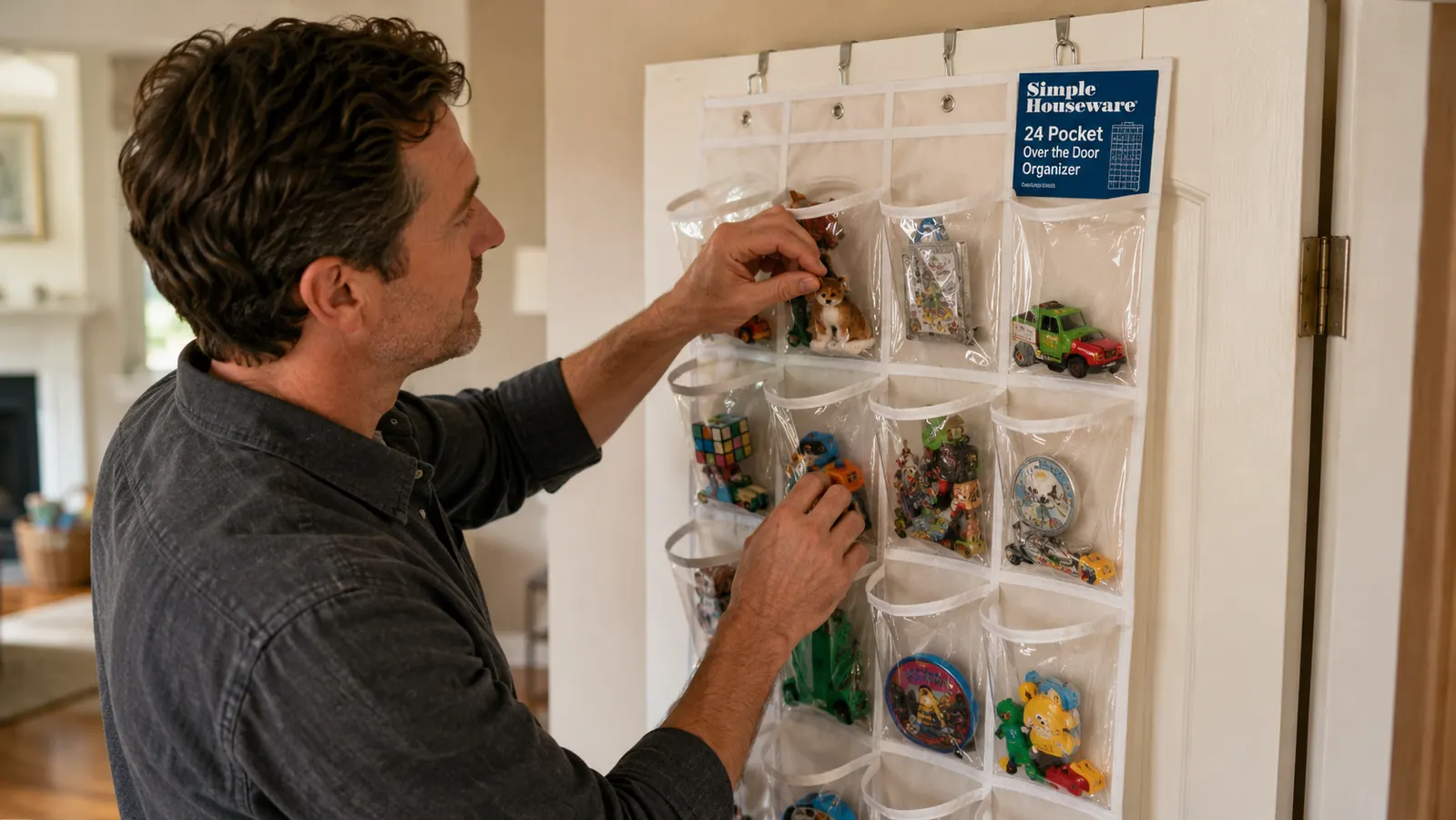
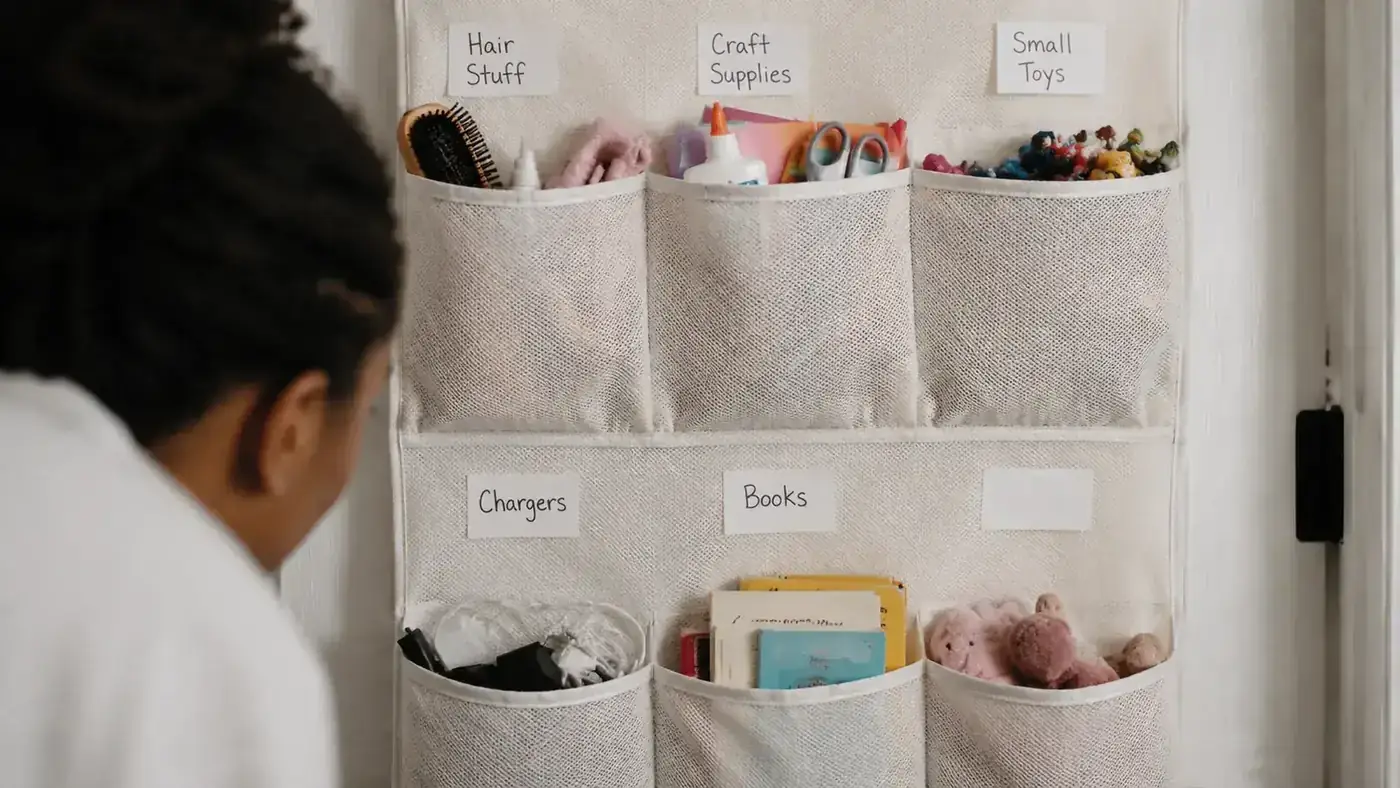
This is the step most people skip, and it is the reason most over-door organizers devolve into a pocket junk drawer within a month. Before you put anything in the organizer, decide which rows belong to which categories and write it down, or better yet, make a simple label for each row. You do not need a label maker. A strip of masking tape and a marker works perfectly and takes three minutes. When your child can read the category before they open the pocket, the system becomes self-instructing.
The Simple Houseware 24-pocket organizer has six rows of four pockets each. That gives you six natural groupings. My suggestion for a typical kid between ages six and twelve: Row 1 at eye level for the things they grab every morning, like hair accessories or glasses cases. Row 2 for art and school supplies. Row 3 for small tech items like earbuds and charging cables. Row 4 for small books, notebooks, and journals. Row 5 for small toys and collectibles. Row 6 at the bottom for anything that does not fit elsewhere. I call Row 6 the Miscellaneous row and keep it intentionally loose.
The eye-level row gets the highest daily-use items because that is where your child looks first. Bottom rows get the lower-frequency stuff. This sounds obvious, but it makes a real difference in whether a six-year-old actually uses the system independently. If the hair ties are at the top and the random keychains are at the bottom, the morning routine does not require help from you. That is the whole point.
Step 4: Hang the Organizer and Do a Trial Fill with Your Kid
Hang the organizer first, empty, then do the initial fill as a five-minute activity with your child rather than for them. This matters more than it sounds. When a kid participates in putting things in, they build a mental map of where things live. When you do it for them and announce the system, they look at it like a foreign object and promptly ignore it. The act of placing things themselves is what builds the memory.
Pick up items from the audit pile you made in Step 1, hold each one up, and ask your child which row makes sense. Let them place it. If they put the markers in the Small Toys row, correct it gently and explain why the Art Stuff row makes the system easier for them, but keep the energy light. You are building buy-in, not enforcing a filing protocol. Ten minutes of this together is worth weeks of reminders later.
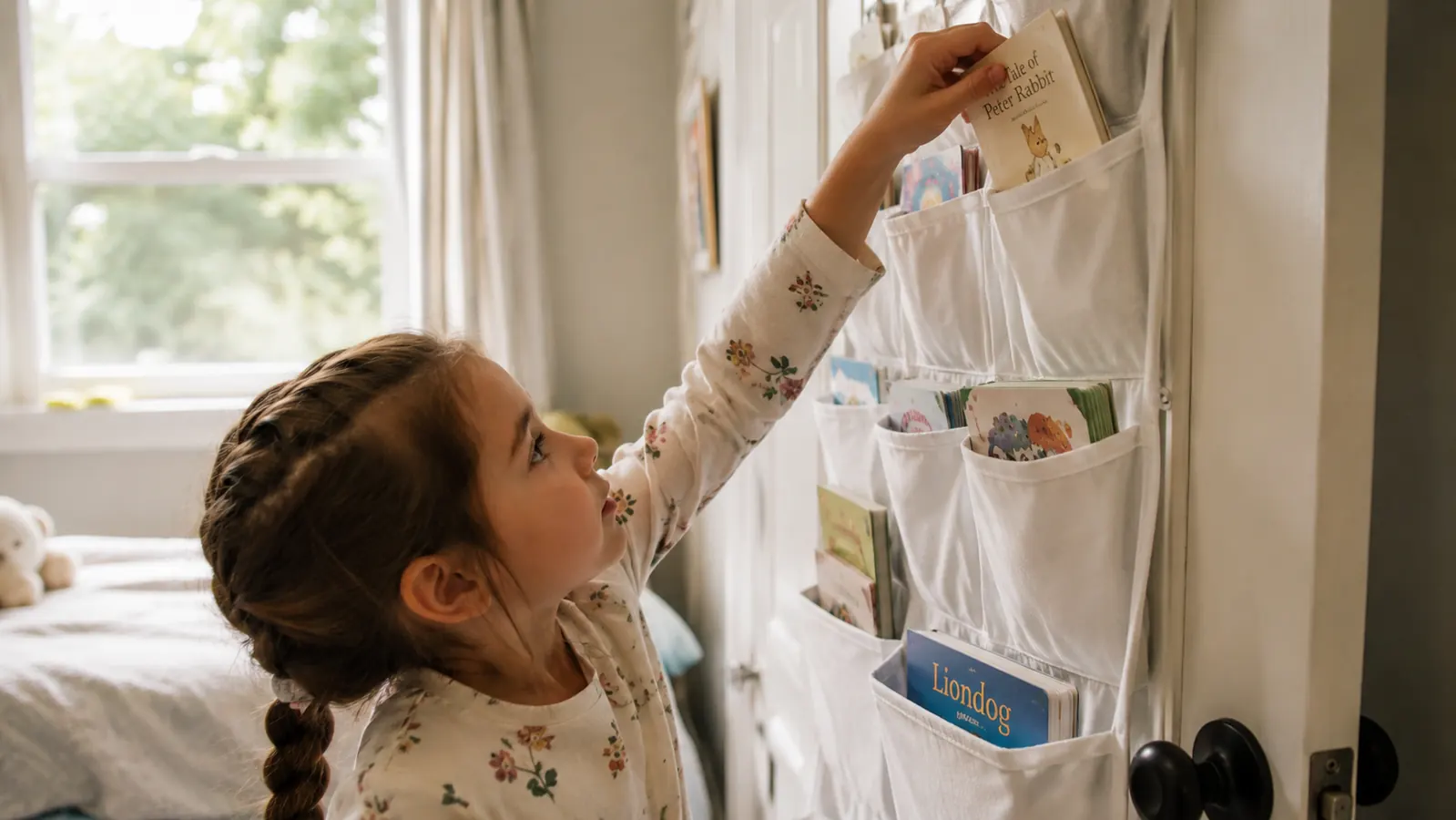
The clear pockets on the Simple Houseware organizer help enormously here. Because you can see through to the contents without opening anything, your child does not have to remember abstract category names. They see their colored pencils and reach for them immediately. That visual transparency is one of the biggest reasons over-door pocket organizers outlast opaque bins for kids' rooms. Open-front storage beats hidden storage in almost every kid-maintained system I have tried.
Step 5: Set a Weekly Reset and Keep It Under Three Minutes
No storage system survives contact with a child without a reset ritual. The goal is not perfection every day. The goal is a weekly moment, ideally tied to something that already happens like putting away laundry or before weekend screen time, where your kid spends two to three minutes returning anything that drifted to the wrong pocket or fell out. That is genuinely all it takes to keep the system working long-term.
The over-door organizer makes the reset fast because everything is visible. There is no digging through a bin to find the bottom layer. Your child can see every pocket at once and spot what is out of place in about thirty seconds. Time that against a drawer organizer where they have to pull the drawer out, shuffle things around, and remember what goes where, and you understand why the visible, always-accessible nature of over-door storage is so much better for kids specifically.
After a few weeks, the reset shrinks naturally because the habit of returning things to pockets builds on its own. My daughter Lily is eight and has been maintaining her over-door organizer almost entirely by herself for four months now. I do a five-minute check on Sundays and usually find two or three things out of place. That is about as close to a self-maintaining system as I have ever built in a kid's space, and I have tried a lot of things.
What Else Helps
The over-door pocket organizer handles the small-item chaos beautifully, but it works best as part of a slightly broader room system. For toys bigger than a pocket can hold, a single low open bin on the floor beats any complex shelving arrangement for kids under ten. For folded clothes, a six-tier hanging closet shelf adds extra storage without requiring your child to wrestle a tall dresser drawer. The principle behind all of these solutions is the same: reduce decisions, make the return path obvious, and keep everything visible. Once you stop asking kids to figure out where things go and just make the right spot the only obvious spot, the cleanup battle mostly disappears. If you want to see how the Simple Houseware organizer holds up over months across different door types and what breaks down with heavy use, the full long-term review covers that in detail. If you are weighing whether over-door storage makes sense for your home versus wall-mounted options, the comparison between over-door organizer vs wall-mounted storage breaks down exactly when each approach wins.
The first week Lily used the organizer, she put her markers away without being asked. I stood in the doorway for a full ten seconds just staring. That had never happened before in four years of trying different systems.
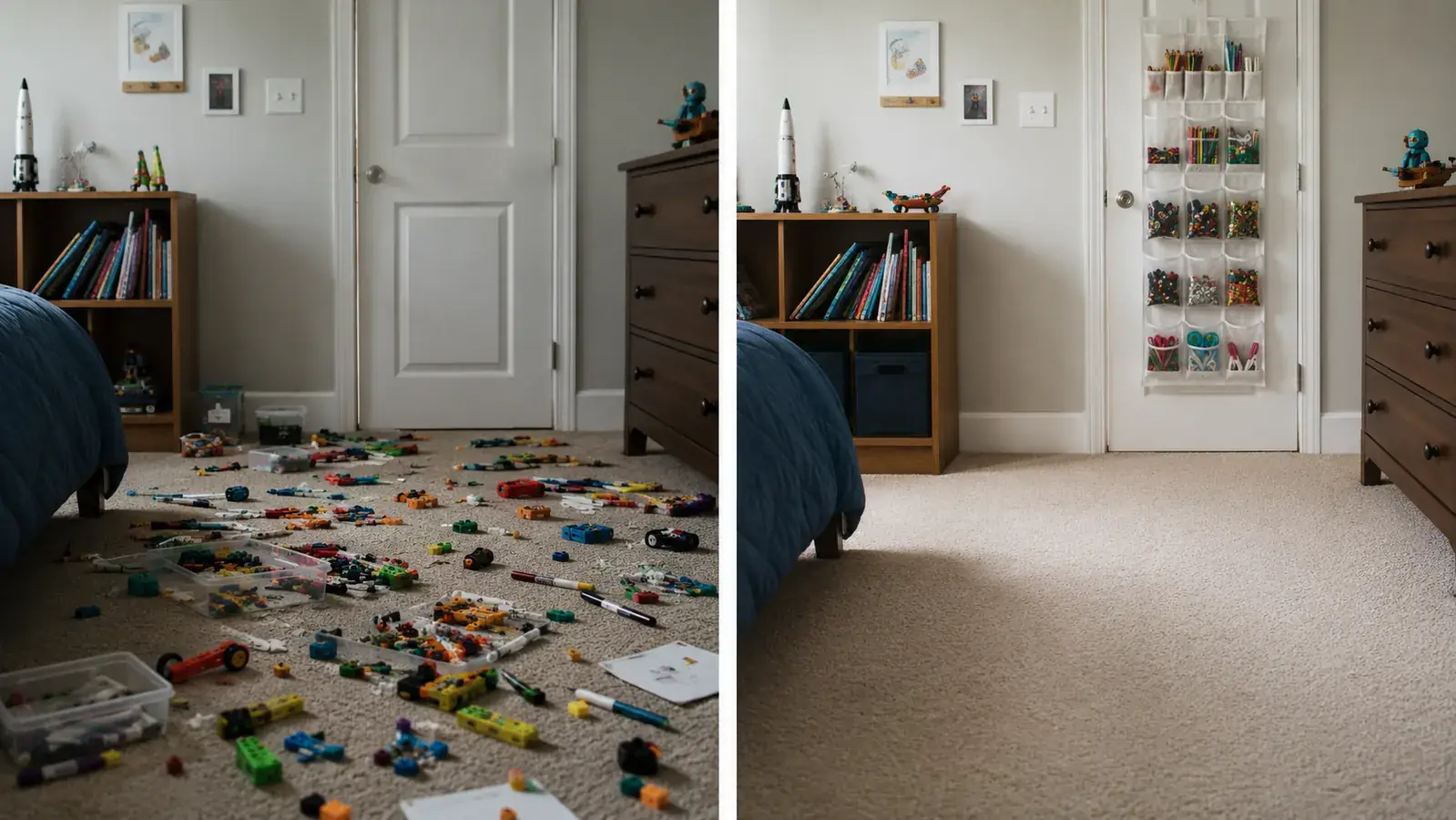
If the small stuff is winning the battle in your kid's room, this is the fix that finally works.
The Simple Houseware 24-pocket over-door organizer installs in under five minutes with no tools, holds dozens of small items in plain sight, and comes off the door without leaving a mark when you move. Over 132,000 families have bought it. Check the current price and see if it ships to you today.
Amazon Check Today's Price on Amazon →